Crowns & Bridges in Sangbong-dong Does a cracked molar always need a crown?
What matters is how much solid tooth wall is left outside the crack. How much the tooth has to be reshaped depends on whether covering just part of the chewing surface will hold up, or the tooth needs to be covered all the way around.
Before Treatment
What do you check on a tooth that hurts when you chew?
- The remaining tooth and root
- We look at the direction of the crack, how deep the cavity goes, and the gums and root. If the root is hard to save, a crown alone is unlikely to solve the problem.
- Where and how hard the teeth touch
- The exam checks which tooth touches first when you close your mouth or move your jaw sideways. If you grind your teeth or the cusps on the chewing surface are thin, the coverage may be extended so those cusps do not break.
Your Options
When do you use an inlay, onlay, crown, or bridge?
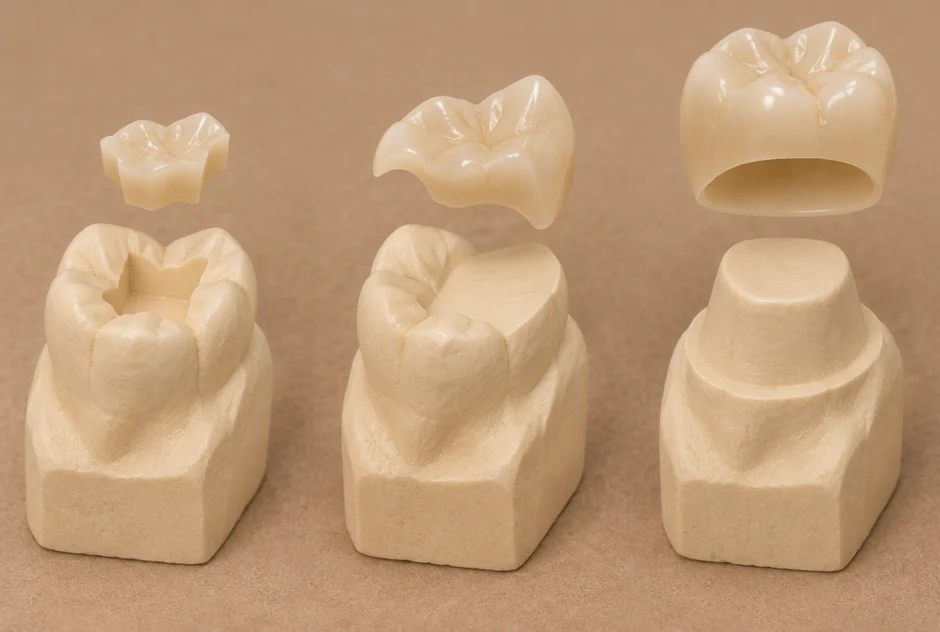
Fits into the hollow inside the tooth.
- Inlay
- When the damage is inside the chewing surface and the outer walls are strong, we bond in a piece made to fit the gap. If the area is small, a tooth-colored filling placed directly may do the job.
- Onlay
- When the cusps on the chewing surface have worn thin, an onlay covers them too. Your dentist checks whether it can protect the areas that take the most force while keeping the walls that remain.
- Crown
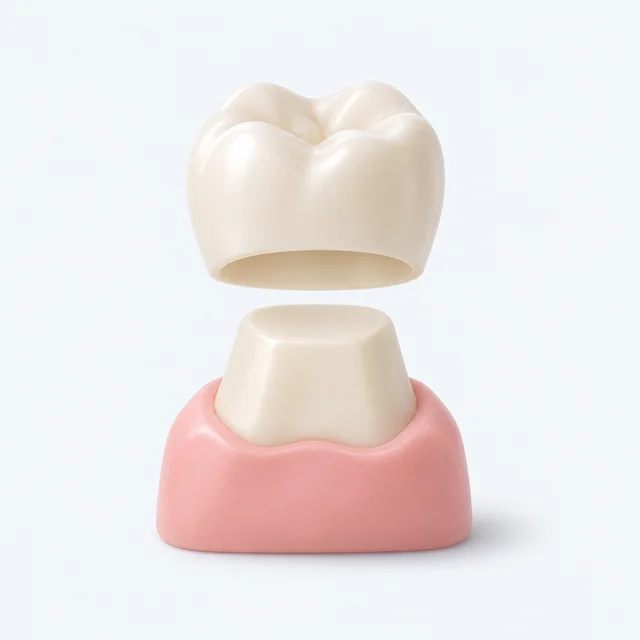
- When little wall is left or the tooth is at high risk of splitting, the tooth is reshaped and covered all the way around. Removed tooth structure doesn't grow back, so it's worth checking first whether partial coverage would work.
- Bridge
- The teeth on either side of the gap support an artificial tooth in between. We weigh the cost of reshaping the neighboring teeth and whether you can clean under the bridge, and compare implants and dentures too.
Treatment Steps & Aftercare
When do you check that the restoration fits well?
Recording the shape
After we prepare the tooth, we record the space for the restoration and the shape of the teeth it bites against. If you have a temporary, avoid hard or sticky foods.
Placement and adjustment
We check where it touches the neighboring teeth, the margin at the gum line, and the height of your bite. If you are still numb, be careful not to bite your cheek or lip while eating.
Cleaning at home
Cavities can form again on the natural tooth next to a restoration. Clean between the teeth and along the gum line, and with a bridge, learn how to slide floss under the connected artificial teeth.
FAQs
If I get a crown, do I need a root canal too?
Whether you need a root canal depends on testing the tissue inside the tooth for inflammation and damage. Even if you need a crown, a healthy nerve can be kept.
Are inlays and onlays made of different materials?
The two names describe how much of the tooth is covered. We choose the material separately, based on the position of the tooth, how much thickness is left, and your chewing force.
Food keeps getting stuck next to my new restoration. Is that OK?
If food keeps catching in the same spot or floss keeps snagging, the contact with the neighboring tooth and the margin should be checked. Tell us which side it is.
Book a Visit
Can I come in about an older restoration?
Tell us which side has been hard to chew on, and since when. If a restoration has come out, or you use a night guard, bring it with you.