Why do wisdom teeth become impacted?
Wisdom teeth come in last, usually from the late teens to early twenties, and by then there's often not enough room at the back of the jaw.
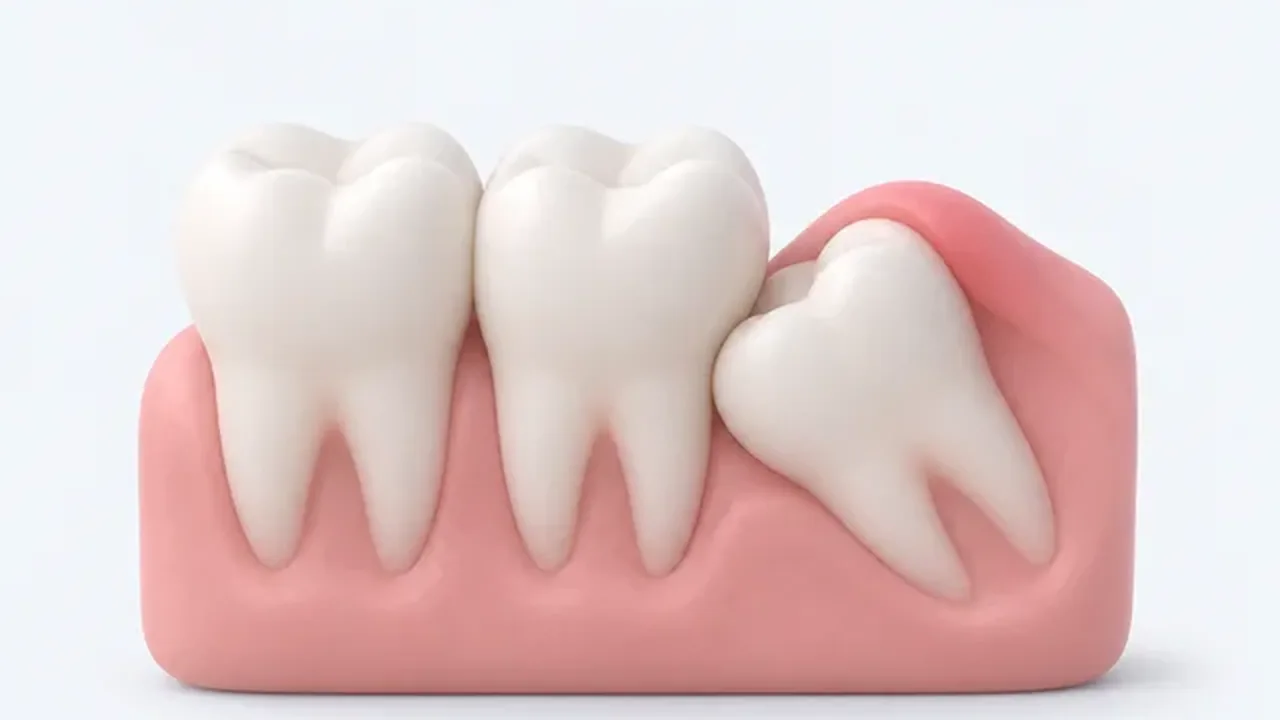
When space runs out, the wisdom tooth gets stuck against the molar in front of it or stops partway, tilted on its side.
Lower wisdom teeth become impacted more often than upper ones.
What shapes can an impacted wisdom tooth take?
Impacted wisdom teeth are grouped by how deeply they're buried and which way they lean.
- Fully impacted: completely buried in gum and bone, not visible in the mouth
- Partially impacted: only part of the tooth has come through the gum
- Angled (mesioangular): tilted toward the molar in front and caught against it
- Horizontal: lying completely on its side
What problems can it cause if left alone?
A partly impacted wisdom tooth traps food between the gum and tooth, so pericoronitis (inflammation of the gum around a wisdom tooth) tends to keep coming back.
If the wisdom tooth is pushing on the molar in front, a cavity can form between the two teeth, or the bone around the root of that molar can break down.
Rarely, the sac around the wisdom tooth enlarges into a cyst.
Do all impacted wisdom teeth have to come out?
If a tooth is fully buried and causing no trouble, we sometimes just monitor it on X-rays at regular checkups.
We often recommend removal if infections keep coming back or the tooth is affecting the tooth in front of it.
The roots of a lower impacted wisdom tooth can sit close to the nerve canal in the lower jaw, so if the panoramic X-ray shows them close together, we measure the distance with a CT scan.
When to come in right away
- Swelling around the wisdom tooth and difficulty opening your mouth
- Swelling in the cheek or under the jaw, with a fever
- Pain that reaches your throat when you swallow
At Jungnang First Dental
At Jungnang First Dental, we use a panoramic X-ray to see how deep your wisdom tooth is buried and which way it's angled, and a CT scan if needed to see how close it is to the nerve.
Then we explain whether to remove it or keep watching it, and why.
We’re open Monday and Friday 9:30 am–8 pm, Tuesday through Thursday 9:30 am–6:30 pm, and Saturday 9:30 am–2 pm.
Call +82-2-2209-2879 to book or ask a question.