What's the biggest difference between the two?
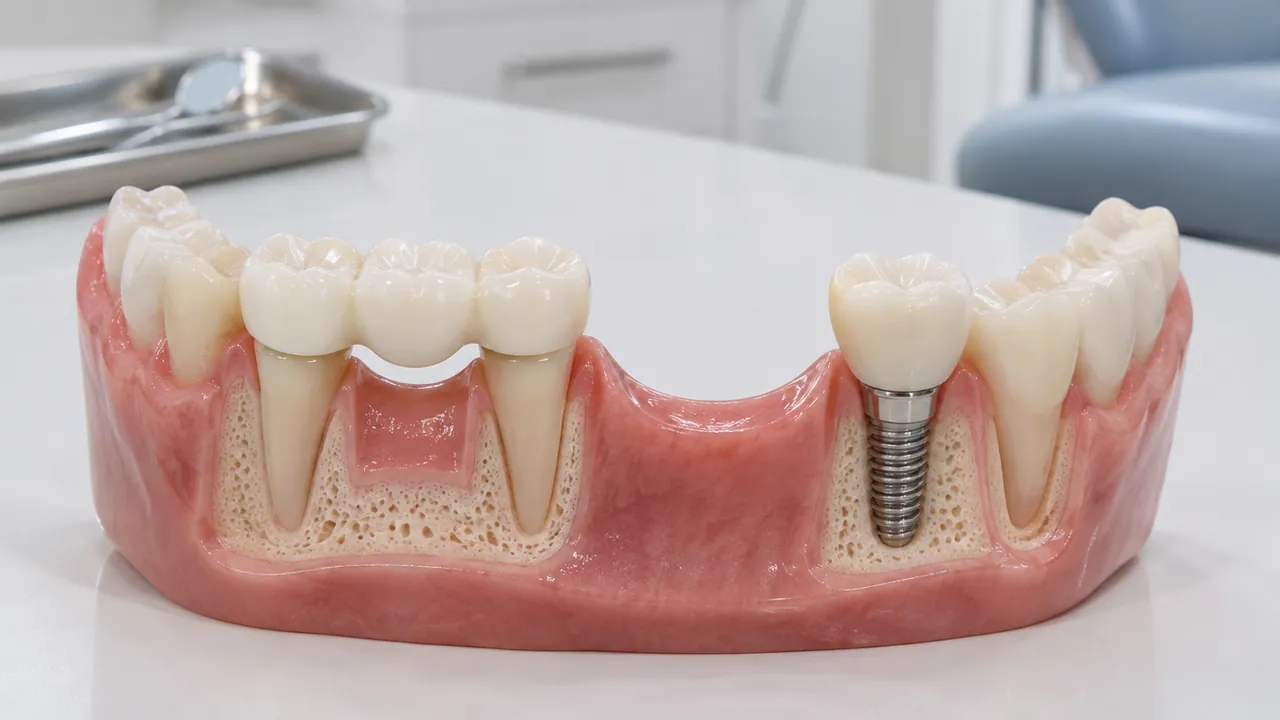
The biggest difference is whether the neighboring teeth have to be altered.
A bridge means trimming the teeth on both sides by the thickness of a crown, even if they're healthy, while an implant treats only the gap and leaves the neighbors alone.
On the other hand, if the neighboring teeth already have large fillings or need crowns anyway, covering them all at once with a bridge can make sense.
How do the timeline and process differ?
A bridge is often finished within 1–2 weeks after the teeth are shaped and impressions are taken.
An implant means waiting a few months for the artificial root to bond firmly with the bone before the tooth is attached, and a bone graft adds more time if you're short on bone.
If diabetes or a medication you take makes surgery a concern, we may consider a bridge first.
How does care differ afterward?
Food gets trapped easily under the false tooth in the middle of a bridge, so you need bridge floss or interdental brushes to clean underneath.
If an anchor tooth gets a cavity, the whole bridge may have to be remade.
The gums around an implant can become inflamed too, so implants need brushing and regular checkups just like natural teeth.
When to come in right away
- A neighboring tooth seems to have tilted into a gap left empty for a long time
- An odor or swollen gums under an existing bridge
At Jungnang First Dental
At Jungnang First Dental, we check the neighboring teeth and jawbone on X-rays and a CT scan, then compare the process, timeline, and care for a bridge and an implant so you can choose.
We'll also go over implant coverage under Korean National Health Insurance for ages 65 and older and the non-covered (out-of-pocket) items at your consultation.
We’re open Monday and Friday 9:30 am–8 pm, Tuesday through Thursday 9:30 am–6:30 pm, and Saturday 9:30 am–2 pm.
Call +82-2-2209-2879 to book or ask a question.